October 14, 2007
Bomb Harvest
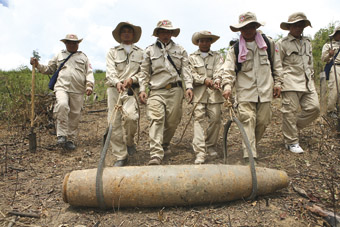
A rookie bomb disposal technician, fresh out of training, is sent on his first big job - defusing a 500 pound bomb in the middle of a small town. One false move and he risks not only turning himself into "pink mist" but destroying a nearby school and the town's power supply... At first blush, this might sound like the storyline from a hit new US TV action series; one in which the bomb was planted by freedom-hating Islamist terrorists... Only it's not. It's part of what unfolds in Bomb Harvest, a documentary by Australian filmmakers, Kim Mordaut and Sylvia Wilczynski, and the villain in this story is a "secret war" conducted the the US in the late 60's and early 70's.
Bomb Harvest is set in Laos and follows the work of the Mines Advisory Group who train locals in the task of defusing ordnance left over from the covert bombing of that country during the Vietnam War... By any estimation, it is a truly Herculean task.
Although it was never officially part of the main conflict, the bombing of Laos - aimed at cutting off Vietcong supply lines snaking through that country - continued in secret for nearly a decade. In the process, it rained down more explosives on Laos than the total dropped by all the Allies in World War II, and turned it into the most bombed country in the world. Most of these bombs exploded, but at least 30% didn't. This means that there are still 15 million pieces of unexploded ordnance scattered in the jungle or buried in fields throughout Laos.
This lethal lingering presence in Laotian life has bred a strange economy that exacerbates the dangers. Tilling soil to plant crops will often unearth the most insidious of these explosives, known as bombies. These are the individual constituents of cluster bombs, custard apple shaped spheres of ball bearings packed around explosives, which are released in their dozens from a single missile and designed to maim but not kill. (The thinking behind them is that a lame combatant or civilian will be more of a drain on an enemy's resources than a dead one.)
With attempts at cultivation turning productive members of communities into invalids, more desperate measures to find an income are resorted to and the most profitable of these is the highly dangerous collection of bombs to sell as scrap metal.
It's a grim situation and its grimness finds expression in the doco with disturbing scenes of children collecting ordnance in the jungle and feeling a palpable sense of regret when a bomb that could've obliterated part of their village but also could've been a gold mine, is successfully defused and carted away.
Despite this, the film is not uncompromisingly grim and dour. Indeed, at times, it is surprisingly funny; thanks to a very droll Australian bomb disposal technician who uses humour to defuse a tense "day at the office", and an ex-monk interpreter who's making up for lost time by drinking like a fish and unsuccessfully cracking on to every woman he meets.
Add to this a series of cleverly assembled montages of Vietnam-era stock footage that provide pungent glimpses into the history, and you have one the best Australian political documentary in quite while. Heavy on character, story and context; but light on didacticism.
After doing the festival circuit, the filmmakers have opted for self-release deals with a number of smaller cinemas like Cinema Nova in Melbourne, and the Roseville Cinema and Randwick Ritz in Sydney. If you get the chance, get along to one of the screenings (check the film's website for more details.)
And if, like me, you are horrified by the insidious evil of cluster bombs (which are still in use today) you might want to put your weight behind this campaign.
October 12, 2007
Australia's Own Blackwater

With the hearings in Washington casting a harsh light on the activities of Blackwater, it's worth remembering that they are not the only private security company in Iraq whose actions have resulted in civilian fatalities. Earlier this week, employees of the Australian-owned firm Unity Resources Group opened fired on a taxi that approached too close to a convoy they were guarding and killed two women. A spokesman for the company claimed that all appropriate warnings were given and that the extreme response was justified by fears of a potential suicide bombing.
Accounts by eyewitnesses, however, paint a somewhat different picture. Although the car did indeed approach the convoy at speed and failed to stop after the immediate firing of flares (possibly because the driver panicked), it was eventually brought to a halt by a shot to its radiator. Only then, when the vehicle was stationary, did two URG guards leave their SUV to open fire on it, killing the driver and and one of the passengers. (A woman and child in the backseat survived.) Once they were dead, the guards then returned to their vehicle and, according to an Iraqi policeman, "sped off like gangsters".
The incident has, naturally, provoked outrage in Iraq and is not the first such killing that URG has been involved in. Last year, they were investigated over the fatal shooting of a 72-year old agriculture professor who was in a car that failed to stop at a checkpoint.
In their defence, the guards did take appropriate steps to warn off the approaching vehicle, but serious questions still need to be asked about their actions after the taxi came to a halt. The Iraqi Interior Ministry is planning to appoint a committee to investigate the incident, but seeing as an Australian company was involved, I think it only right and proper that an Australian Royal Commission be set up to conduct their own inquiries. We owe it to the families of the victims, the incensed Iraqi populace, and any of our nationals on the ground who may be doing positive work and face having their image tarnished and lives threatened as a result of this incident.
If you agree with me, then I urge you to send an email to our Attorney-General Phillip Ruddock demanding the immediate establishment of a Royal Commission into this tragedy. He can be contacted via this web page.
October 10, 2007
Oiled Man Gets Licked By Dog On Japanese TV
Japanese TV continues to push the boundaries of popular entertainment and grace us with unparalleled moments of meme-spawning video weirdness. Although it might lack the drama and tension of Human Tetris or the sheer terror of Lizard vs Morning Musume, there is something surreally compelling about watching a self-conscious metrosexual in briefs offer up his armpits and knees to the ardent attentions of a canine tongue. The judges of this "talent show" obviously don't know what to make of it, so they resort to scoring his butt. (via TV In Japan)
Stylishly Violent And Anatomically Correct

Here are two blogs that have me enthralled at the moment but which may not be suitable for the squeamish. Who Killed Bambi? has very little text but plenty of arresting images of art with violent, gory or morbid themes. Morbid Anatomy is the bloggy love child of Joanna Ebenstein, a NYC graphic designer with a passion for medical art and objets d'art. I will be eternally grateful to her for alerting to the existence of this wonderful shop which I will be making a beeline for if I ever get back to New York.
October 04, 2007
From Fair-Go To Rip-Off: An Economist Sinks The Boot Into WorkChoices
The new Australian labour code is such a massive break with Western labour traditions that it merits global attention. It is an extreme change with no economic rationale. Social scientists would love to see the data the new law generates; it would be a great ‘natural experiment.’ For the sake of Australians, however, it would be great to see the upcoming election put an end to the experiment.
So says Richard B. Freeman... And why should we listen to him? Because he is a professor of economics at Harvard who specialises in labour studies. If you can stomach his cringeworthy references to "kangaroo stew" and "platypus pie" then I thoroughly recommend reading his assessment of WorkChoices. (via Australia's best political blog, Blogocracy)
Abandoned Wonders Of The Modern World

I've recently been reading The World Without Us, Alan Weisman's compelling meditation on the what might happen to the Earth if we all suddenly disappeared, so these lists of abandoned wonders of the modern world immediately appealed to me. (They even include a place mentioned in that book - the deserted Cypriot resort town of Varosha.) Other obvious highlights are Pripyat in the exclusion zone surrounding Chernobyl, and the former Japanese coal mining island of Gunkanjima (The photo at the top of this post is from OrigamiKid's flickr set of photos of that island.) (via Web Urbanist)
A Murmuration Of Starlings

Another video of photos and commentary; this time of the flocks of starling who crowd the skies over Rome each winter. As the above image indicates, this isn't just a modest gathering of bodies on the wing but a massed multitude of titanic proportions who return from the countryside each night to roost. The images were snapped by Richard Barnes and the words were provided by Jonathon Rosen. (via the Lens Culture blog) (BTW 'murmuration' is apparently the collective noun for starlings.)
Vodou Brooklyn
At a Buddhist interfaith event in New York, photographer Stephanie Keith met a Haitian Vodou priest who invited her to come and photograph one of their ceremonies in the Flatbush area of Brooklyn. She became something of a regular at these all-night rituals, and now shares her experiences with the world via this video featuring her images and commentary. (via Metafilter)
October 03, 2007
Angkor Photography Festival
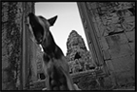 It's not uncommon to find photography festivals with positive political agendas; festivals that choose works designed to expose a cause, and use proceeds from the sale of those works to support those advancing that cause. What's less common is what happens at the Angkor Photography Festival.
At this festival, photographers not only exhibit their works, they also get to participate in outreach programs that put cameras and basic photographic skills in the hands of local street kids, the disabled, and women with HIV/AIDS. The results of these programs are then posted on Flickr so they can acquire a global audience (cf this street kid photoset)
This year, the festival is also using Flickr to promote a competition for non-professional photographers. The theme: Asia in the World (ie photos taken in Asia, or of Asian culture in the world) The deadline is October 31st.