October 14, 2007
Bomb Harvest
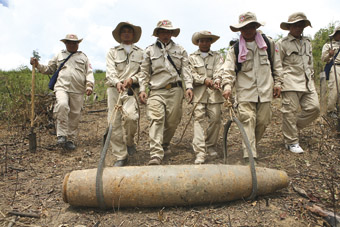
A rookie bomb disposal technician, fresh out of training, is sent on his first big job - defusing a 500 pound bomb in the middle of a small town. One false move and he risks not only turning himself into "pink mist" but destroying a nearby school and the town's power supply... At first blush, this might sound like the storyline from a hit new US TV action series; one in which the bomb was planted by freedom-hating Islamist terrorists... Only it's not. It's part of what unfolds in Bomb Harvest, a documentary by Australian filmmakers, Kim Mordaut and Sylvia Wilczynski, and the villain in this story is a "secret war" conducted the the US in the late 60's and early 70's.
Bomb Harvest is set in Laos and follows the work of the Mines Advisory Group who train locals in the task of defusing ordnance left over from the covert bombing of that country during the Vietnam War... By any estimation, it is a truly Herculean task.
Although it was never officially part of the main conflict, the bombing of Laos - aimed at cutting off Vietcong supply lines snaking through that country - continued in secret for nearly a decade. In the process, it rained down more explosives on Laos than the total dropped by all the Allies in World War II, and turned it into the most bombed country in the world. Most of these bombs exploded, but at least 30% didn't. This means that there are still 15 million pieces of unexploded ordnance scattered in the jungle or buried in fields throughout Laos.
This lethal lingering presence in Laotian life has bred a strange economy that exacerbates the dangers. Tilling soil to plant crops will often unearth the most insidious of these explosives, known as bombies. These are the individual constituents of cluster bombs, custard apple shaped spheres of ball bearings packed around explosives, which are released in their dozens from a single missile and designed to maim but not kill. (The thinking behind them is that a lame combatant or civilian will be more of a drain on an enemy's resources than a dead one.)
With attempts at cultivation turning productive members of communities into invalids, more desperate measures to find an income are resorted to and the most profitable of these is the highly dangerous collection of bombs to sell as scrap metal.
It's a grim situation and its grimness finds expression in the doco with disturbing scenes of children collecting ordnance in the jungle and feeling a palpable sense of regret when a bomb that could've obliterated part of their village but also could've been a gold mine, is successfully defused and carted away.
Despite this, the film is not uncompromisingly grim and dour. Indeed, at times, it is surprisingly funny; thanks to a very droll Australian bomb disposal technician who uses humour to defuse a tense "day at the office", and an ex-monk interpreter who's making up for lost time by drinking like a fish and unsuccessfully cracking on to every woman he meets.
Add to this a series of cleverly assembled montages of Vietnam-era stock footage that provide pungent glimpses into the history, and you have one the best Australian political documentary in quite while. Heavy on character, story and context; but light on didacticism.
After doing the festival circuit, the filmmakers have opted for self-release deals with a number of smaller cinemas like Cinema Nova in Melbourne, and the Roseville Cinema and Randwick Ritz in Sydney. If you get the chance, get along to one of the screenings (check the film's website for more details.)
And if, like me, you are horrified by the insidious evil of cluster bombs (which are still in use today) you might want to put your weight behind this campaign.